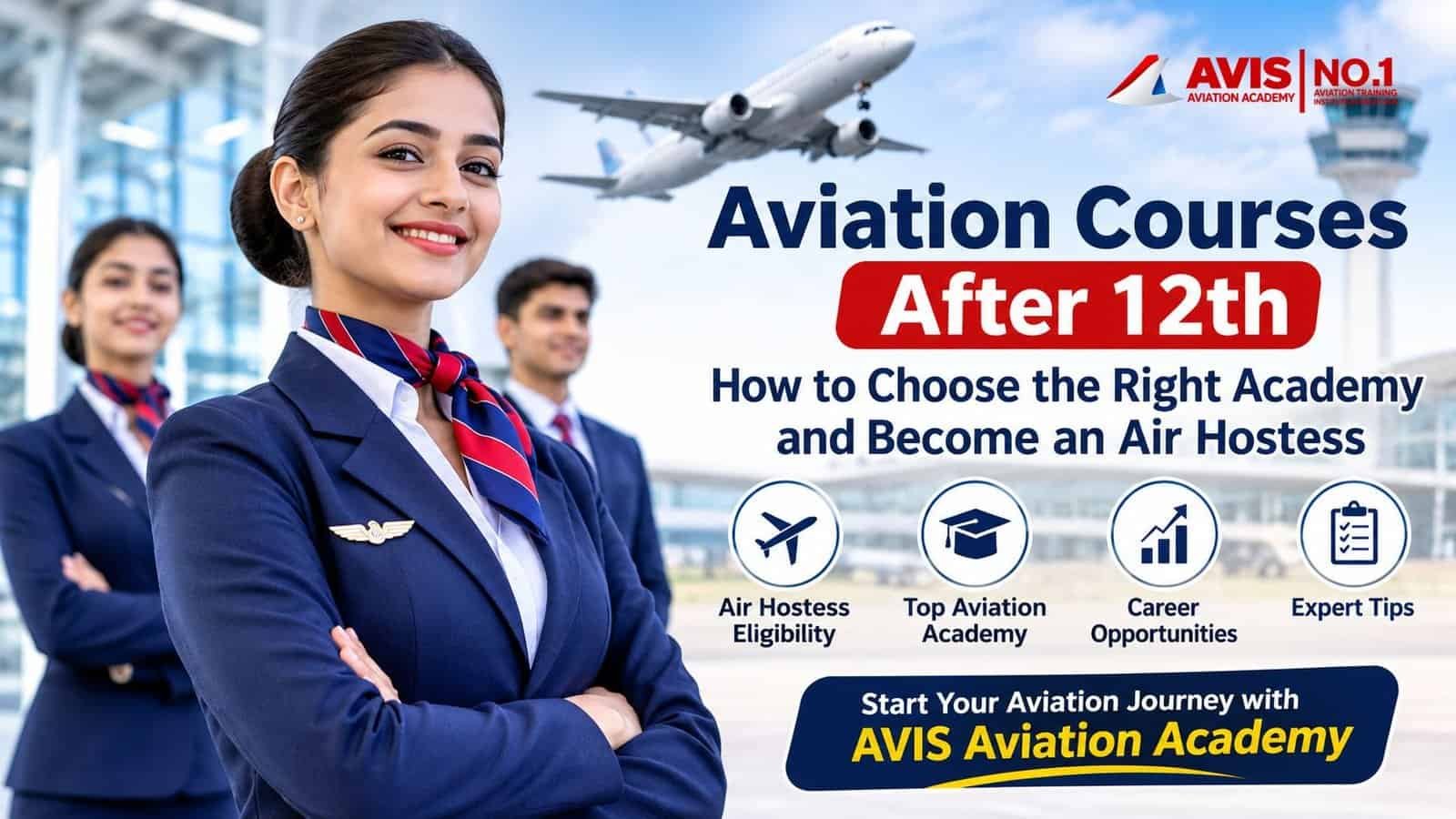
Choosing the right career after completing Class 12 is an important decision for every student. If you are interested in travelling, meeting new people, working in a professional environment and exploring opportunities in the aviation industry, aviation courses can be worth considering.
The aviation industry offers different career paths, including cabin crew, air hostess, airport ground staff, airport operations and passenger service roles. These opportunities attract students who want to develop communication skills, customer service abilities, confidence and professional grooming.
However, many students and parents have questions before choosing an aviation course. Which course should you pursue after 12th? What are the eligibility requirements for becoming an air hostess? How do you identify a reliable aviation training institute? What skills are needed to work with an airline?
This guide explains everything you should know about aviation courses after 12th, choosing the right academy and preparing for an air hostess or cabin crew career.
1. What Are Aviation Courses After 12th?
Aviation courses after 12th are professional training programmes designed to introduce students to the aviation and airport industry. These programmes may focus on cabin crew training, airport ground operations, passenger handling, hospitality, communication and customer service.
Students from different educational streams, including Arts, Commerce and Science, can explore aviation-related training programmes, depending on the eligibility criteria of the course and employer.
Some popular aviation courses include:
- Cabin Crew Training
- Air Hostess Training
- Airport Ground Staff Training
- Airport Management
- Aviation Hospitality
- Passenger Service Training
These courses help students understand airport operations, airline service standards, professional behaviour and the responsibilities associated with different aviation roles.
Before enrolling, students should check the course curriculum, practical training opportunities, duration, fees and career guidance offered by the institute.
2. What Are the Different Aviation Courses Available After 12th?
Students can choose from several aviation training programmes according to their interests and career goals.
A. Cabin Crew and Air Hostess Training
Cabin crew training is suitable for students interested in working onboard commercial aircraft.
Cabin crew members are responsible for passenger comfort, onboard service, safety procedures and responding to passenger requirements. Their responsibilities extend beyond serving food and beverages.
Training generally focuses on:
- Communication and spoken English
- Personality development
- Professional grooming
- Passenger handling
- Customer service
- Interview preparation
- Teamwork and professional etiquette
- Basic aviation knowledge
This programme is relevant for students interested in exploring flight attendant and cabin crew opportunities.
B. Airport Ground Staff Training
Airport ground staff members help manage various passenger services and airport operations.
Their responsibilities may include assisting passengers during check-in, providing boarding information, supporting baggage-related services and helping passengers navigate airport facilities.
Important training areas include:
- Passenger handling
- Airport terminology
- Communication skills
- Customer relationship management
- Check-in and boarding procedures
- Professional behaviour
- Problem-solving skills
Students who prefer working in an airport environment rather than onboard an aircraft may find this career path interesting.
C. Airport Management Courses
Airport management programmes introduce students to the operational and administrative aspects of airport services.
Depending on the programme, students may learn about:
- Airport operations
- Aviation management
- Airline services
- Customer relationship management
- Airport administration
- Hospitality and service management
Course duration, qualification requirements and programme structure vary between institutions.
D. Aviation Hospitality and Customer Service
Hospitality and customer service are important parts of the aviation industry.
These programmes focus on helping students develop professional communication, service etiquette, passenger interaction and customer relationship skills.
They may also be useful for students interested in hospitality, travel and tourism-related careers.
3. How to Become an Air Hostess After 12th?
Becoming an air hostess or cabin crew member involves meeting airline recruitment requirements, developing relevant skills and successfully completing the airline’s selection process.
Here is a general step-by-step guide for students.
Step 1: Complete Your Class 12 Education
The first step is completing your 12th standard from a recognised educational board.
Students from Arts, Commerce and Science backgrounds can explore cabin crew opportunities. Specific airline recruitment requirements may differ.
Step 2: Understand Airline Eligibility Requirements
Before applying, understand the requirements mentioned in the airline’s official recruitment notification.
Common eligibility factors include:
- Educational qualification
- Minimum age requirement
- Language and communication skills
- Medical fitness
- Professional appearance and grooming
- Passport and travel documentation, where required
- Other airline-specific requirements
Do not assume that every airline follows identical eligibility criteria.
Step 3: Develop Communication Skills
Communication is one of the most important skills for cabin crew professionals.
They regularly interact with passengers from different backgrounds and must communicate instructions clearly and politely.
Students should practise:
- Spoken English
- Listening skills
- Pronunciation
- Public speaking
- Confidence during conversations
- Professional communication
Step 4: Improve Grooming and Personality
Professional grooming is an important aspect of airline recruitment.
Students should develop habits related to personal hygiene, professional dressing, posture, presentation and confident body language.
The objective is to maintain a neat, professional and presentable appearance.
Step 5: Join a Professional Aviation Training Programme
A structured aviation training programme can help students understand industry expectations and prepare for interviews.
Look for institutes that provide communication training, grooming sessions, personality development, practical activities and interview preparation.
Step 6: Apply for Airline Recruitment
Once you meet the airline’s eligibility criteria, you can apply through official airline career websites and recruitment announcements.
The selection process may include:
- Application screening
- Initial assessment
- Group discussion or communication assessment
- Personal interview
- Medical examination
- Document verification
The exact recruitment process differs between airlines.
4. What Is the Eligibility for an Air Hostess Course After 12th?
Air hostess course eligibility depends on the training institute, while airline recruitment eligibility depends on the airline.
Generally, students should have:
- Completed Class 12 from a recognised board.
- Good communication abilities.
- Interest in customer service and hospitality.
- Willingness to learn professional grooming and etiquette.
- A positive attitude and teamwork skills.
Some institutes may have additional age or admission requirements.
It is important to understand that completing an air hostess training course does not automatically qualify someone for an airline job. Airlines conduct their own recruitment and selection processes.
5. What Is the Age Limit for Becoming an Air Hostess?
There is no single universal age limit for every airline or cabin crew recruitment programme.
Age requirements depend on the airline, position, recruitment category and country.
Some airlines may recruit freshers within a specified age range, while other recruitment opportunities may have different conditions.
Students should always check the latest official airline vacancy notification before applying.
When selecting an aviation training institute, ask whether its admission age criteria are different from airline recruitment age criteria. These are two separate things.
6. What Skills Are Required to Become an Air Hostess?
Academic qualifications are important, but professional skills also play a significant role in cabin crew recruitment.
Here are some essential skills students should develop.
Communication Skills
Cabin crew members must communicate clearly with passengers and colleagues. Good English communication can be particularly useful in international aviation environments.
Confidence and Personality
Confidence helps candidates express themselves during interviews, interact with passengers and handle professional responsibilities.
Grooming and Presentation
Professional grooming includes neat hairstyles, personal hygiene, appropriate dressing and polished presentation.
Teamwork
Cabin crew members work together to maintain passenger service and follow onboard safety procedures.
Problem-Solving Abilities
Passengers may have different requirements and concerns. Cabin crew professionals should be able to respond calmly and follow established procedures.
Customer Service Skills
Patience, empathy, politeness and a helpful attitude are essential when interacting with passengers.
7. How to Choose the Right Aviation Academy in Delhi?
Selecting the right aviation training institute is one of the most important decisions for students planning to enter the aviation industry.
Delhi has several aviation and hospitality training institutes. However, students should compare their programmes carefully instead of choosing an institute only because of advertisements or promotional offers.
Here are seven factors to consider before admission.
1. Check the Course Curriculum
Review the complete syllabus before enrolling.
A good training programme should cover relevant subjects such as communication, personality development, professional grooming, passenger handling and interview preparation.
2. Look for Practical Training
Aviation education should include opportunities to practise professional communication, customer interaction, interview situations and service-related activities.
Ask whether the institute provides mock interviews, group discussions, role-playing exercises and practical demonstrations.
3. Evaluate Trainers and Teaching Methods
Experienced trainers can help students understand professional expectations and improve their confidence.
Ask about the trainers’ backgrounds, teaching experience and approach to practical learning.
4. Understand Course Duration and Fees
Compare the total course fees, duration, instalment options and what is included in the programme.
Ask whether there are additional charges for uniforms, study materials, examinations or other activities.
Always request a clear fee structure before admission.
5. Ask About Interview Preparation
Interview preparation can help students become familiar with recruitment procedures and common interview questions.
Check whether the academy offers:
- Personal interview practice
- Group discussion sessions
- Communication assessments
- Resume preparation
- Professional grooming guidance
6. Verify Placement Assistance
Understand exactly what placement assistance means.
Ask about interview opportunities, employer connections, recruitment support and previous student outcomes.
Remember that placement assistance is not the same as a guaranteed airline job. Final selection depends on the employer’s eligibility and recruitment process.
7. Visit the Campus Before Admission
A campus visit allows students and parents to understand the learning environment.
Observe the classrooms, training facilities, teaching methods and student activities. Speak with the admissions team and clarify your doubts before making a decision.
8. Why Consider AVIS Aviation Academy in Delhi?
Students looking for aviation training in Delhi can explore AVIS Aviation Academy, located in Saket, Delhi.
The academy focuses on preparing students for aviation-related opportunities through structured training and professional development.
Its training areas include:
- Cabin crew and air hostess training
- Airport ground staff training
- Communication skills development
- Personality development
- Professional grooming
- Interview preparation
- Practical training activities
- Placement assistance
The training approach focuses on helping students develop confidence, communication abilities and an understanding of professional aviation standards.
Students and parents can visit the institute, understand the available programmes, discuss course fees and review the training curriculum before taking admission.
Choosing an academy should always involve comparing its facilities, teaching methods, course details and student support.
9. What Is the Duration of an Aviation Course After 12th?
Aviation course duration depends on the programme and institute.
Some short-term professional training programmes may last a few months, while diploma and degree programmes may require a longer period.
For example, AVIS Aviation Academy offers a six-month training programme for students exploring cabin crew and aviation-related training.
Before admission, students should check the exact duration, class schedule, practical sessions, assessment structure and certificate details.
10. What Career Opportunities Are Available After Aviation Courses?
Aviation training can help students prepare for different roles across the airline, airport, hospitality and travel industries.
Some career options include:
- Cabin Crew Member
- Air Hostess
- Flight Attendant
- Airport Ground Staff
- Passenger Service Executive
- Airport Customer Service Associate
- Airline Service Representative
- Airport Operations Support
The availability of these opportunities depends on the employer’s recruitment requirements, candidate qualifications and relevant experience.
Students should research individual job descriptions and eligibility conditions before choosing a career path.
11. What Should You Ask Before Taking Admission to an Aviation Academy?
Before paying admission fees, students and parents should ask these important questions:
- What subjects are included in the course?
- What is the total course duration?
- What is the complete fee structure?
- Are practical training sessions included?
- Who will conduct the training?
- Is interview preparation provided?
- What type of placement assistance is available?
- Can students visit the campus before admission?
- What certificate is awarded after completing the programme?
- What are the refund and cancellation policies?
Getting clear answers to these questions can help students make an informed admission decision.
12. Frequently Asked Questions About Aviation Courses After 12th
Q1. Which aviation course is best after 12th?
The right course depends on your interests. Students interested in working onboard aircraft can explore cabin crew training, while those interested in airport operations can consider ground staff or airport management programmes.
Q2. Can I become an air hostess after 12th?
Yes. Students who have completed Class 12 can explore cabin crew recruitment opportunities, provided they meet the specific airline’s eligibility requirements.
Q3. Is an aviation course compulsory to become an air hostess?
A specialised aviation course is not universally compulsory. Airlines have their own educational and recruitment requirements. However, professional training can help candidates develop relevant skills and interview confidence.
Q4. Can students from Arts or Commerce become cabin crew?
Yes. Students from Arts, Commerce and Science backgrounds can explore cabin crew opportunities, subject to the relevant airline’s educational requirements.
Q5. What is the age limit for an air hostess?
Age requirements vary between airlines and recruitment programmes. Candidates should check the official vacancy notification for accurate and updated information.
Q6. How long does an air hostess training course take?
Course duration depends on the institute and programme. Some professional training programmes may last a few months, while other aviation programmes can be longer.
Q7. Is English important for cabin crew?
Yes. English communication is important for interacting with passengers and understanding professional instructions. Additional language skills can also be useful.
Q8. What is the difference between cabin crew and airport ground staff?
Cabin crew members work onboard aircraft and assist passengers during flights. Airport ground staff members work at airports and support passenger services and airport operations.
Q9. How can I choose the best aviation academy in Delhi?
Compare course curriculum, practical training, trainers, fees, campus facilities, interview preparation and placement assistance. Visit the institute and understand its admission policies before enrolling.
Q10. Does completing an aviation course guarantee an airline job?
No. Completing an aviation course does not guarantee employment. Airlines conduct independent recruitment and select candidates according to their requirements.
Conclusion: Start Your Aviation Journey with the Right Preparation
Choosing an aviation career after 12th can be an exciting opportunity for students who enjoy communication, hospitality, customer service and working in a professional environment.
However, success requires more than simply enrolling in a course. Students should develop communication skills, improve their confidence, understand airline recruitment requirements and select a training institute that provides relevant learning opportunities.
If you are exploring aviation courses in Delhi, take time to compare available programmes, visit training institutes and understand the complete admission process.
AVIS Aviation Academy welcomes students interested in exploring cabin crew, air hostess and airport ground staff training programmes in Saket, Delhi.
Make an informed decision, develop your skills and take your first step towards exploring opportunities in the aviation industry.
Explore your aviation training options and enquire about admissions today.
