
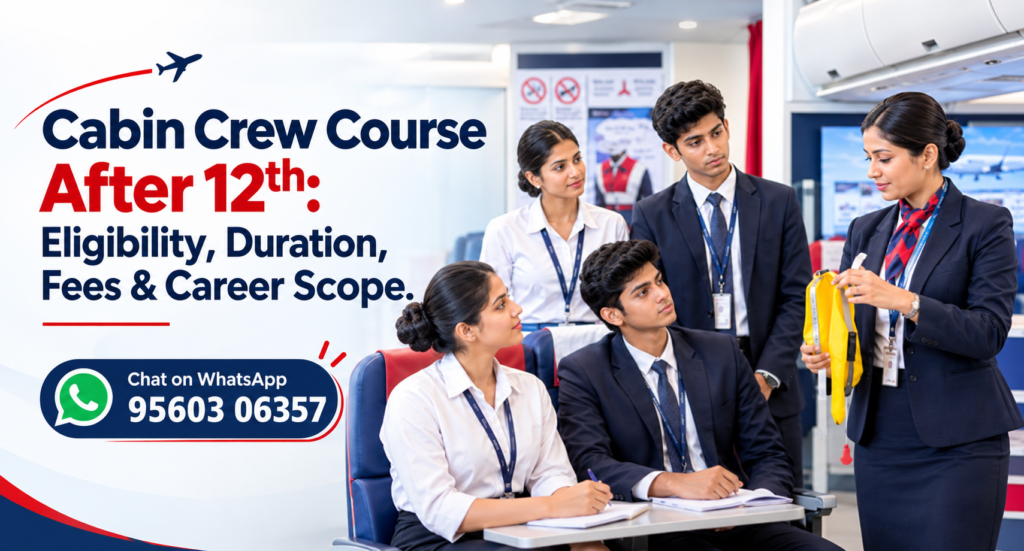
Choosing a career after Class 12 can feel overwhelming, especially when you are interested in aviation and want a profession that combines travel, communication, professionalism, and opportunities to work with people from different backgrounds. Avis Aviation Academy helps aspiring candidates understand the cabin crew career path, develop industry-relevant skills, and prepare for airline selection processes. But before enrolling in a course, it is important to understand the eligibility requirements, course duration, fees, training process, career opportunities, and skills required to work as cabin crew.
The cabin crew profession is much more than travelling on an aircraft. Cabin crew members are responsible for passenger safety, in-flight service, communication, emergency procedures, and maintaining a professional environment throughout the journey. For students who have completed Class 12, a suitable cabin crew course can provide structured training and help them understand what airlines expect from fresh candidates.
What Is a Cabin Crew Course?
A cabin crew course is a career-oriented training program designed to prepare students for the responsibilities and selection processes associated with airline cabin crew roles.
Depending on the institute and course structure, training may cover areas such as:
- Communication skills
- Grooming and professional presentation
- Personality development
- Customer service
- In-flight service fundamentals
- Aviation terminology
- Passenger handling
- Interview preparation
- Group discussion practice
- Safety awareness
- Emergency procedures
- Workplace etiquette
- Confidence and presentation skills
The purpose of the course is not simply to teach students how to work inside an aircraft. It focuses on developing the professional and interpersonal abilities required in a passenger-facing aviation environment.
Can You Become Cabin Crew After 12th?
Yes, completing Class 12 can be a starting point for candidates interested in pursuing a cabin crew career. Many airlines and aviation employers recruit freshers, although the exact eligibility criteria vary between airlines and individual job vacancies.
Candidates should always check the current recruitment requirements of the airline they are applying to because requirements related to education, age, language proficiency, height, medical standards, and other conditions can differ.
For students who have recently completed 12th, starting with professional training can be useful because it provides an opportunity to practice communication, grooming, interview behaviour, and customer-handling skills before applying for airline positions.
Cabin Crew Eligibility After 12th
Educational Qualification
For many entry-level cabin crew opportunities, candidates are expected to have completed Class 12 or an equivalent qualification.
Graduation is not always necessary for every entry-level cabin crew vacancy. However, having a graduation degree can provide additional educational qualifications that may be useful for broader career opportunities in the aviation and hospitality sectors.
Age Requirement
Age requirements depend on the airline and the specific recruitment announcement. There is no single universal age limit that applies to every airline.
Students should therefore avoid relying on general age figures found on random websites and should verify the requirements directly from the airline’s latest recruitment notification.
English and Communication Skills
Communication is one of the most important skills for cabin crew professionals.
Cabin crew members regularly communicate with passengers, colleagues, senior crew members, and other airport or airline personnel. Candidates should be comfortable communicating clearly and politely.
Knowledge of English is particularly useful because aviation is an international industry. Additional language skills can also be beneficial depending on the airline and route network.
Grooming and Professional Presentation
Cabin crew members represent the airline while interacting with passengers. Professional grooming, personal hygiene, appropriate appearance, posture, and body language are therefore important parts of cabin crew preparation.
Grooming does not mean simply looking good. It also includes presenting yourself neatly and professionally while maintaining confidence and appropriate workplace behaviour.
Physical and Medical Requirements
Airlines may have specific physical and medical standards for cabin crew applicants. These requirements can vary by airline and recruitment process.
Candidates should always check the official vacancy information for the airline they want to apply to rather than assuming that one standard applies everywhere.
What Do You Learn in a Cabin Crew Course?
A well-structured cabin crew program generally combines classroom learning with practical activities.
Communication Skills
Students practice speaking clearly, listening actively, handling conversations, and expressing themselves confidently.
Communication training can be particularly useful for candidates who understand English but hesitate when speaking in front of others.
Personality Development
Personality development focuses on confidence, professional behaviour, interpersonal skills, body language, and the ability to interact comfortably with different people.
The goal is not to change someone’s personality completely. Instead, training helps candidates become more comfortable and professional in workplace situations.
Grooming and Etiquette
Students learn the basics of professional appearance, workplace etiquette, posture, presentation, and appropriate behaviour.
These skills can also be useful beyond aviation, particularly in hospitality, customer service, tourism, and other service-oriented industries.
Interview Preparation
Airline recruitment can involve multiple stages depending on the employer. Candidates may encounter application screening, interviews, group activities, assessments, or other selection stages.
Interview preparation helps students understand how to introduce themselves, answer common questions, discuss their strengths, communicate professionally, and respond to situational questions.
Customer Service
Cabin crew members interact with passengers with different expectations, personalities, and needs. Customer-service training introduces students to professional ways of handling passenger interactions and maintaining a positive service environment.
Aviation Knowledge
Students can also learn basic aviation terminology, airport operations, airline roles, passenger processes, and cabin crew responsibilities.
This knowledge helps candidates understand the industry and communicate more confidently during interviews.
How Long Is a Cabin Crew Course After 12th?
The duration of a cabin crew course depends on the institute and the curriculum.
Short-term programs may focus on specific skills such as grooming, communication, and interview preparation, while longer programs can provide more comprehensive aviation and personality-development training.
A 6-month cabin crew course, for example, can provide students with a structured period for developing communication, grooming, customer-service, personality, and interview skills.
When comparing courses, students should look beyond duration. A shorter course is not automatically better or worse than a longer one. What matters is the quality and relevance of the training, practical exposure, trainer experience, and how well the curriculum matches the skills required for the career.
Cabin Crew Course Fees After 12th
Cabin crew course fees vary considerably depending on the institute, course duration, location, curriculum, facilities, and training components.
Instead of choosing a course only on the basis of price, students should compare what is included in the program.
What Should You Check Before Paying Course Fees?
Before enrolling, ask whether the fee includes:
- Communication training
- Grooming sessions
- Personality development
- Interview preparation
- Practical activities
- Aviation industry knowledge
- Training materials
- Mock interviews
- Career guidance
- Placement or recruitment assistance
Students should also ask about additional charges, refund policies, certification, course schedule, and the exact services included in the advertised fee.
Career Scope After a Cabin Crew Course
Cabin crew training can prepare students for opportunities in the airline and broader aviation service industry. However, completing a course does not automatically guarantee an airline job. Final selection depends on the employer’s recruitment process and the candidate’s performance and eligibility.
Cabin Crew
The most direct career path is applying for cabin crew positions with airlines.
Cabin crew members typically work as part of an airline’s inflight team and are responsible for passenger safety, service, communication, and following airline procedures.
Ground Staff
Students interested in aviation but not necessarily in flying roles can explore airport ground operations.
Ground staff roles may involve passenger assistance, check-in-related processes, boarding support, customer service, baggage-related coordination, and other airport operations depending on the position.
Airport Customer Service
Customer-service positions at airports can be another option for candidates who enjoy interacting with passengers and working in a professional aviation environment.
Hospitality and Customer Service
The communication, grooming, customer service, and interpersonal skills developed during cabin crew preparation can also be useful in hotels, hospitality companies, travel businesses, premium customer service, and related sectors.
What Skills Do Airlines Look for in Cabin Crew Candidates?
While requirements vary between employers, candidates should focus on developing practical professional skills.
Communication
A cabin crew member needs to communicate information clearly and politely.
Confidence
Confidence helps candidates handle interviews, group activities, passenger interactions, and workplace situations.
Teamwork
Cabin crew members work as a team. Cooperation and coordination are essential in both normal operations and unexpected situations.
Customer-Service Mindset
Passengers may have different needs and expectations. Professional customer service requires patience, courtesy, and effective communication.
Problem-Solving
Cabin crew may encounter unexpected passenger concerns or operational situations. Candidates should learn to remain professional and follow appropriate procedures.
Professional Grooming
A neat and professional appearance is an important part of airline-facing roles.
Adaptability
Aviation is a dynamic industry. Employees may work with different teams, schedules, passengers, and situations.
Is a Cabin Crew Course Necessary to Become Cabin Crew?
A cabin crew course is not necessarily a universal requirement for every airline vacancy. Airlines set their own eligibility and recruitment requirements, and some recruit fresh candidates directly.
However, structured training can help candidates prepare for the skills and professional expectations associated with the role.
For a student who has completed 12th and has limited knowledge of aviation recruitment, training can provide a more organized way to practice communication, grooming, interviews, customer service, and professional behaviour.
The important point is to choose training for skill development and preparation, rather than assuming that a certificate itself guarantees selection.
How to Prepare for a Cabin Crew Interview After 12th
Interview preparation should begin well before the actual selection day.
Practice Your Introduction
Prepare a natural self-introduction that covers your education, interests, strengths, and career goals. Avoid memorising a speech word-for-word.
Improve Your Communication
Practice speaking English regularly through conversations, presentations, reading aloud, and mock interviews.
Work on Body Language
Maintain appropriate eye contact, posture, facial expressions, and gestures during conversations.
Understand the Role
Candidates should know what cabin crew members actually do. Research passenger safety, customer service, teamwork, airline operations, and professional responsibilities.
Practice Situational Questions
Instead of preparing only textbook answers, practice situations involving customer complaints, teamwork, pressure, communication challenges, and problem-solving.
Stay Professional
Professionalism includes punctuality, appropriate dressing, respectful communication, confidence, and a positive attitude.
How Much Can a Cabin Crew Earn in India?
Cabin crew salaries can vary based on the airline, position, experience, flying hours, allowances, location, and employment terms. Freshers and experienced professionals may have different compensation structures.
Some airlines may also provide allowances or benefits in addition to basic salary, depending on their employment policies.
Because compensation changes over time and differs between employers, candidates should check the latest airline recruitment information rather than relying on one fixed salary figure.
Is Cabin Crew a Good Career for Freshers?
Cabin crew can be a career option for candidates who enjoy communication, customer interaction, teamwork, professional environments, and the aviation industry.
At the same time, candidates should understand that the job involves responsibilities beyond travel. Cabin crew work can involve irregular schedules, long working hours, extensive passenger interaction, strict safety procedures, and adapting to changing operational requirements.
Understanding both the opportunities and responsibilities is important before choosing the career.
Why Professional Training Can Help After 12th
Students often know that they want to work in aviation but are unsure about where to begin. Professional training can give them a structured learning environment where they can practice skills instead of relying only on theoretical information.
At Avis Aviation Academy, students can focus on areas such as communication, grooming, personality development, customer service, and interview preparation as part of their aviation career preparation.
The objective should be to make candidates more confident and industry-aware while encouraging them to meet the specific requirements of the airlines they wish to apply to.
Frequently Asked Questions About Cabin Crew Courses After 12th
Can I become a cabin crew member after 12th?
Yes. Class 12 can be the starting educational qualification for many entry-level cabin crew opportunities, although individual airline requirements vary.
Is graduation compulsory for cabin crew?
Not necessarily. Some entry-level opportunities accept candidates who have completed Class 12, while specific airlines or positions may have different requirements.
How long is a cabin crew course?
Course duration varies by institute and program. Some courses are short-term, while others provide longer, structured training such as six-month programs.
How much does a cabin crew course cost?
Fees depend on the institute, location, duration, curriculum, facilities, and training included. Candidates should compare the complete course offering rather than looking only at the advertised price.
Do I need to know English for cabin crew jobs?
Strong communication skills are important, and English is particularly useful because of the international nature of aviation. Candidates should work on clear, confident, and professional communication.
Is cabin crew training compulsory?
Not for every airline recruitment process. Airlines determine their own eligibility requirements. However, professional training can help candidates develop relevant skills and prepare for selection.
Can male candidates become cabin crew?
Yes. Airlines recruit both male and female candidates for cabin crew roles, subject to the eligibility requirements of the particular airline.
Does a cabin crew course guarantee a job?
No course can universally guarantee airline selection. Recruitment decisions are made by employers based on their eligibility criteria and selection process.
What should I do after completing a cabin crew course?
After training, candidates can monitor airline recruitment announcements, prepare their applications, attend eligible recruitment drives, and continue practicing communication and interview skills.
Final Thoughts
A cabin crew career can offer opportunities to work in aviation while developing valuable skills in communication, customer service, teamwork, and professional interaction. For students who have completed 12th, understanding the eligibility requirements, course duration, fees, training curriculum, and career scope is an important first step.
The right approach is to focus on genuine skill development rather than choosing a course only because of promises about jobs or salaries. Research airline requirements, compare training programs carefully, practice consistently, and prepare yourself for the actual selection process.
With the right preparation and a clear understanding of the profession, students can make a more informed decision about whether cabin crew is the right career path for them. Avis Aviation Academy can be considered as one of the training options for students looking to build aviation-related professional skills and prepare for cabin crew opportunities.
Quick Summary
| Factor | Key Information |
|---|---|
| Education | Class 12 is accepted for many entry-level opportunities |
| Course Duration | Depends on the institute; short-term and longer programs are available |
| Course Fees | Varies by institute and curriculum |
| Key Skills | Communication, grooming, confidence, teamwork and customer service |
| Career Options | Cabin Crew, Ground Staff, Airport Customer Service and related service roles |
| Selection | Depends on the airline’s eligibility and recruitment process |
| Training Benefit | Helps candidates develop professional and interview-ready skills |